
Read Our Reviews on:


What if busy season is not a capacity problem in finance teams, but the most accurate stress test of how your workflows, reporting processes, and operational systems behave under pressure?
For most finance leaders, busy season is framed as an operational peak with long hours, compressed timelines, and heightened scrutiny across reporting, reconciliation, and close cycles. Once it ends, the natural response is recovery: clearing backlog, normalizing workload distribution, and returning to steady-state operations.
But in more mature finance functions, busy season is not treated as a disruption to be endured. It is treated as a diagnostic window for system performance. When volume increases beyond normal thresholds, workflows stop behaving in ideal conditions.
They reveal how intake functions, how work moves across systems, where approvals accumulate friction, and how much effort is required just to maintain continuity. This is why leading firms do not only recover after busy season. They rebuild workflows based on what the system revealed under stress.
Key Takeaways
- Busy season is a stress test of accounting and finance workflow architecture, not just workload pressure
- The primary operational cost in finance operations is rework caused by fragmented accounting systems and disconnected workflows
- Workflow breakdowns consistently appear in intake, review structure, system integration, and documentation consistency
- High-performing finance teams use post-busy season periods for structural workflow redesign, not just recovery
- Modern accounting and finance operations are shifting from task management toward workflow engineering and system design thinking
- The goal of redesign is predictability and stability under scale, not just faster execution
Busy Season Exposes Workflow Gaps not just Workload
From a finance operations perspective, busy season functions as a real-time stress test of end-to-end workflow design from intake to reporting and close. Under normal conditions, inefficiencies are often absorbed through manual coordination, informal escalation paths, and senior staff intervention.
The system appears functional because human effort compensates for structural gaps. Once volume scales, those compensations become insufficient. Across finance teams and CPA environments, the same breakdown patterns consistently emerge:
- Intake variability where financial data, documents, and client submissions enter through inconsistent channels without a standard structure
- Workflow fragmentation, where work moves across disconnected systems such as spreadsheets, ERPs, shared drives, and email threads without a unified process spine
- Review concentration risk where approvals and validations accumulate at senior levels, creating predictable bottlenecks during peak load
These are not new problems created by the busy season. They are pre-existing structural inefficiencies that only become visible when the system is fully utilized. Industry insights across accounting operations consistently reinforce this pattern: busy season does not create failure points; it exposes them by removing operational buffers.
The Real Cost is Rework Not Overtime
Finance teams often evaluate busy season performance through visible indicators such as overtime hours, staffing strain, or extended working schedules. While these metrics matter, they do not reflect the deeper operational cost structure. The more significant issue is rework caused by workflow fragmentation and inconsistent system design.
Rework typically manifests in several ways:
- Data must be re-entered because systems are not integrated end-to-end
- Count reconciliations are delayed due to incomplete or inconsistent upstream financial inputs
- Work is returned for correction because validation rules are unclear or inconsistently applied
- Finance teams repeatedly rebuild operational context as accounting tasks move across functions, reviewers, and disconnected systems
In fragmented finance environments, teams become the integration layer between disconnected systems. Instead of executing structured workflows, they continuously repair them. Over time, this shifts the nature of finance work itself.
A growing portion of effort is no longer directed at processing financial activity, but at maintaining operational coherence across systems that do not naturally align. This is where inefficiency compounds, not in individual tasks, but in the structure connecting those tasks.
From Recovery Mode to Redesign
After the busy season, organizations and firms typically follow one of two paths. The first is operational recovery: clearing backlog, restoring capacity, and reinforcing existing processes without fundamentally changing how workflows. This stabilizes the immediate environment but preserves structural inefficiencies.
The second is workflow redesign, which is increasingly adopted by high-performing finance organizations. Instead of focusing on output recovery, these firms focus on system behavior.
They ask:
- Where did work slowdown under load?
- Where did dependencies break?
- Where did control become dependent on individuals rather than structure?
This aligns with broader trends in finance transformation, where post-peak periods are increasingly used to evaluate and reset workflow design rather than simply restore operational baseline.
In practice, this means shifting attention away from isolated process fixes and toward end-to-end workflow architecture.
- What a workflow breakdown looks like in finance operations
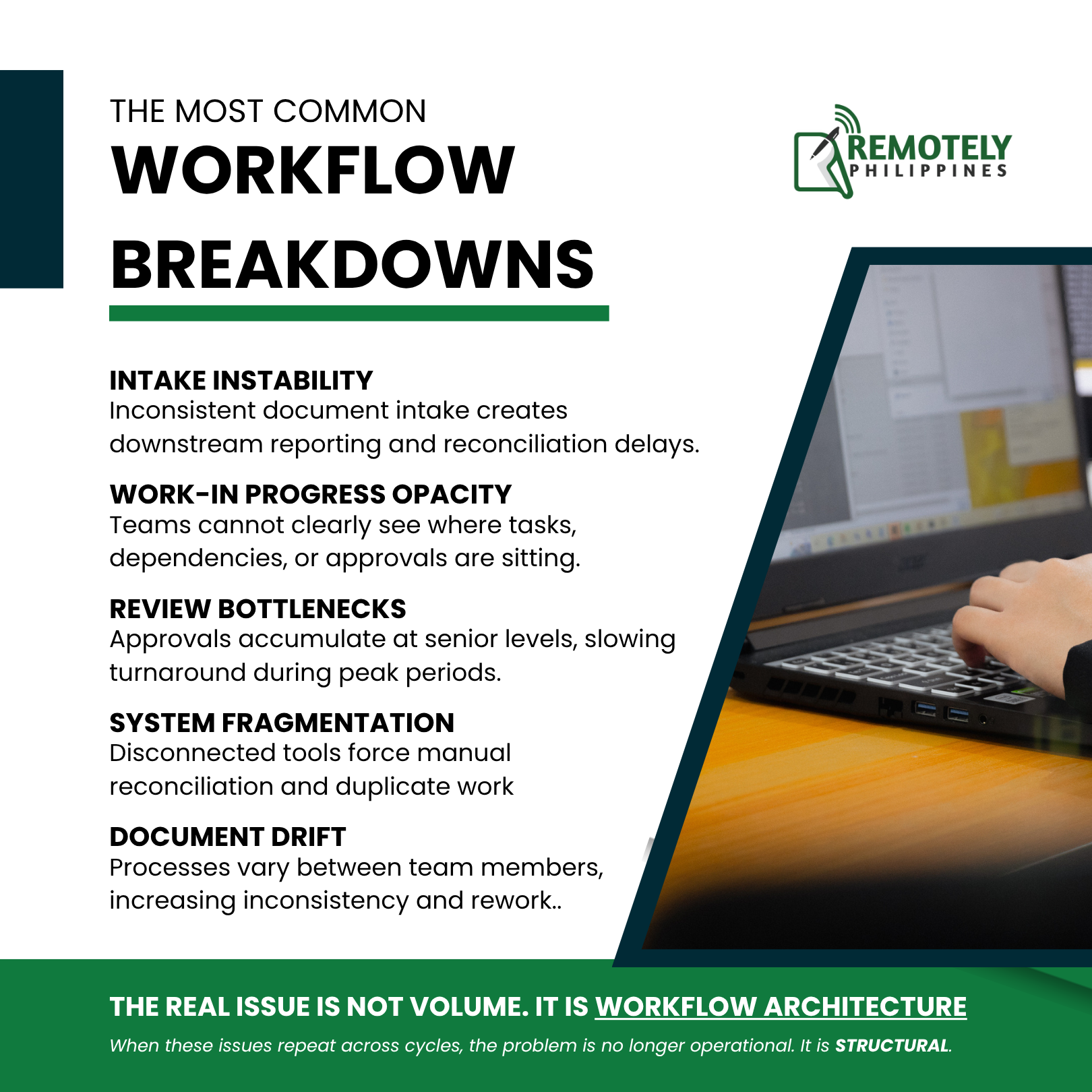
When finance teams map workflows after the busy season, breakdowns rarely appear as isolated incidents. They cluster into systemic categories that repeat across cycles and functions. - Intake instability
There is no consistent structure governing how financial inputs enter the system. This creates upstream variability that affects every downstream process, from reconciliation to reporting. - Work-in-progress opacity
Teams lack real-time visibility into where work sits within the process. Status tracking becomes manual, and dependencies are managed through communication rather than system logic. - Review bottlenecks
Approval structures are not distributed. Instead, they concentrate at senior levels, creating predictable congestion points during high-volume periods. - System fragmentation
Multiple tools operate in parallel without integration. This forces manual reconciliation across platforms and increases the likelihood of inconsistencies. - Documentation drift
Process execution varies across individuals due to incomplete standardization, leading to inconsistent outputs and increased correction cycles.
Individually, these issues may appear operational. Collectively, they reflect a deeper issue: workflow architecture is not fully designed for scale.
From Task Execution to Workflow Engineering
The evolution of modern accounting and finance operations is increasingly defined by a shift from task management toward workflow engineering and scalable processes. Task management focuses on assigning and tracking discrete activities. It assumes efficiency comes from improving how individual tasks are executed.
Workflow engineering operates at a different level. It focuses on how work moves through a system how it is initiated, routed, validated, and completed in a structured and predictable way.
In practical terms, this involves:
- Standardizing intake to reduce variability at the entry point
- Defining clear workflow stages that replace informal coordination
- Embedding validation and control logic within the workflow itself
- Reducing unnecessary system switching by consolidating execution environments
- Introducing automation for repetitive, rules-based finance processes
This approach does not eliminate complexity in finance operations. Instead, it contains complexity within a structured system that can absorb scale without breakdown. When workflows are engineered effectively, performance becomes less dependent on individual intervention and more dependent on system design integrity.
Why Timing Matters: The Post-Busy Season Advantage
The period immediately following the busy season is uniquely valuable for workflow evaluation. During this window, finance leaders typically have:
- Complete visibility into full-cycle operations
- Recent breakdowns still clearly identifiable
- Reduced operational pressure, allowing for deeper analysis
- Cross-functional alignment on pain points and bottlenecks
This combination creates an opportunity that does not exist during peak operations: the ability to observe system failure without operational interference. However, this window is temporary. As normal operations resume, urgency returns, and attention shifts back to execution.
When this happens, structural inefficiencies often persist unaddressed until the next cycle exposes them again. This is why firms that do not act during this period tend to experience recurring inefficiencies year over year.
FAQs
List of Services
-
1. Why is busy season important for finance workflow analysis?List Item 1
The busy season exposes how workflows perform under maximum operational load, revealing structural inefficiencies that are not visible during normal operations.
-
2. What is the most common workflow failure in finance teams?List Item 3
Inconsistent intake processes that create variability across reconciliation, reporting, and review stages.
-
3. How is workflow engineering different from process improvement?List Item 4
Process improvement focuses on optimizing individual tasks, while workflow engineering focuses on how tasks connect and function as an integrated system.
-
4. Can automation solve workflow issues in finance operations?
Only when workflows are already standardized. Automation applied to fragmented processes often amplifies inefficiencies.
-
5. When is the best time to redesign finance workflows?
Immediately after busy season, when system breakdowns are visible, recent, and supported by complete operational data.
-
6. What causes workflow bottlenecks during busy season?
Workflow bottlenecks typically occur when approvals, reconciliations, and reporting reviews rely heavily on manual coordination or concentrated reviewer dependency.
-
7. How can finance teams reduce manual rework?
Finance teams reduce rework by standardizing workflows, improving system integration, automating repetitive tasks, and implementing structured review processes.
-
8. What is workflow engineering in finance operations?
Workflow engineering focuses on how accounting and finance work moves through systems, approvals, validation stages, and reporting processes in a scalable and predictable manner.
Conclusion: Busy Season Reveals the Limits of Accounting and Finance Systems
Busy season is often treated as a period to endure, but in well-designed finance organizations, it functions as a structured diagnostic of workflow performance under real operational load. It removes the buffer between design and reality.
What remains is the true behavior of the system, how intake functions under pressure, how work moves across stages, where dependencies slow execution, and how much effort is required to maintain operational continuity. This is why the most effective finance teams do not treat post-busy season as a recovery phase alone. They treat it as a redesign window.
Once operations return to normal volume, the same structural inefficiencies do not disappear. They simply become less visible until the next cycle makes them unavoidable again. Workflow redesign after the busy season is not about doing more work efficiently.
It is about building finance systems that remain stable, predictable, and scalable regardless of volume conditions. High-performing finance organizations increasingly prioritize workflow discipline, process standardization, and scalable operational support to improve reporting reliability and maintain stability during peak operational periods.
Sign up for our newsletter
Get regular curated content on management, outsourcing, and everything you need to know to stay ahead of the curve.
Newsletter
More Articles