

Read Our Reviews on:


Is your finance team operating at full potential or simply doing its best to keep up?
Most finance leaders have a good sense of how their teams are performing. Month-end closes are completed, reports are submitted on time, and client deliverables continue to move forward. From the outside, everything appears to be running smoothly. But beneath those successful outcomes, a different story may be unfolding.
Senior accountants are spending more time preparing routine work than reviewing it. Controllers are postponing process improvement initiatives because operational demands consume most of their week. Managers are working longer hours just to maintain the same level of output, while strategic projects continue to move down the priority list.
These situations rarely develop overnight. They build gradually as organizations grow, workloads increase, and responsibilities shift. Over time, what begins as temporary pressure can become the team's normal way of working.
The challenge is that many of these risks remain hidden until they result in employee burnout, declining engagement, costly errors, or the departure of key talent. That's why finance leaders need a more structured way to evaluate the health of their teams, not just their performance.
Key Takeaways
- Talent risk extends beyond employee turnover and includes workload sustainability, organizational structure, and leadership capacity.
- A Talent Risk Scorecard helps finance leaders evaluate four critical areas: capacity strain, retention exposure, role misalignment, and leadership bandwidth.
- Small operational pressures often accumulate over time before becoming visible organizational risks.
- A structured 45-minute leadership discussion can uncover bottlenecks, identify root causes, and prioritize practical improvements.
- Organizations that regularly assess talent risk are better equipped to build resilient, scalable finance functions.
A Talent Risk Scorecard helps organizations identify operational and workforce risks before they become business problems.
Rather than relying on instinct or waiting for warning signs to become obvious, finance leaders can use a consistent framework to assess whether their teams have the capacity, structure, and leadership support needed to sustain long-term growth.
To help finance leaders evaluate these hidden risks objectively, we have developed a practical Talent Risk Scorecard framework that measures four areas that often determine whether a finance function is resilient or quietly approaching its limits.
But first, let us define what it is.
What Is a Talent Risk Scorecard?
A Talent Risk Scorecard is a structured assessment designed to evaluate the overall health of a finance function. Instead of measuring individual employee performance, it focuses on the organizational conditions that influence productivity, retention, resilience, and long-term scalability.
The purpose is not to assign grades or evaluate employees. Rather, it provides leadership with a clearer understanding of where operational pressure exists and whether current ways of working remain sustainable. This becomes increasingly important as finance teams take on broader responsibilities.
Today's accounting professionals are expected to support compliance, financial reporting, business analysis, technology adoption, and strategic decision-making, often without proportional increases in resources.
As expectations continue to grow, finance leaders need visibility into the factors that may quietly limit their team's effectiveness. Our Talent Risk Scorecards focus on four key dimensions: capacity strain, retention exposure, role misalignment, and leadership bandwidth.
The Four Dimensions of Talent Risk
Every finance organization is different, but the challenges affecting performance are often surprisingly similar. A Talent Risk Scorecard helps leaders evaluate four areas that frequently determine whether a finance function remains resilient or becomes increasingly vulnerable.
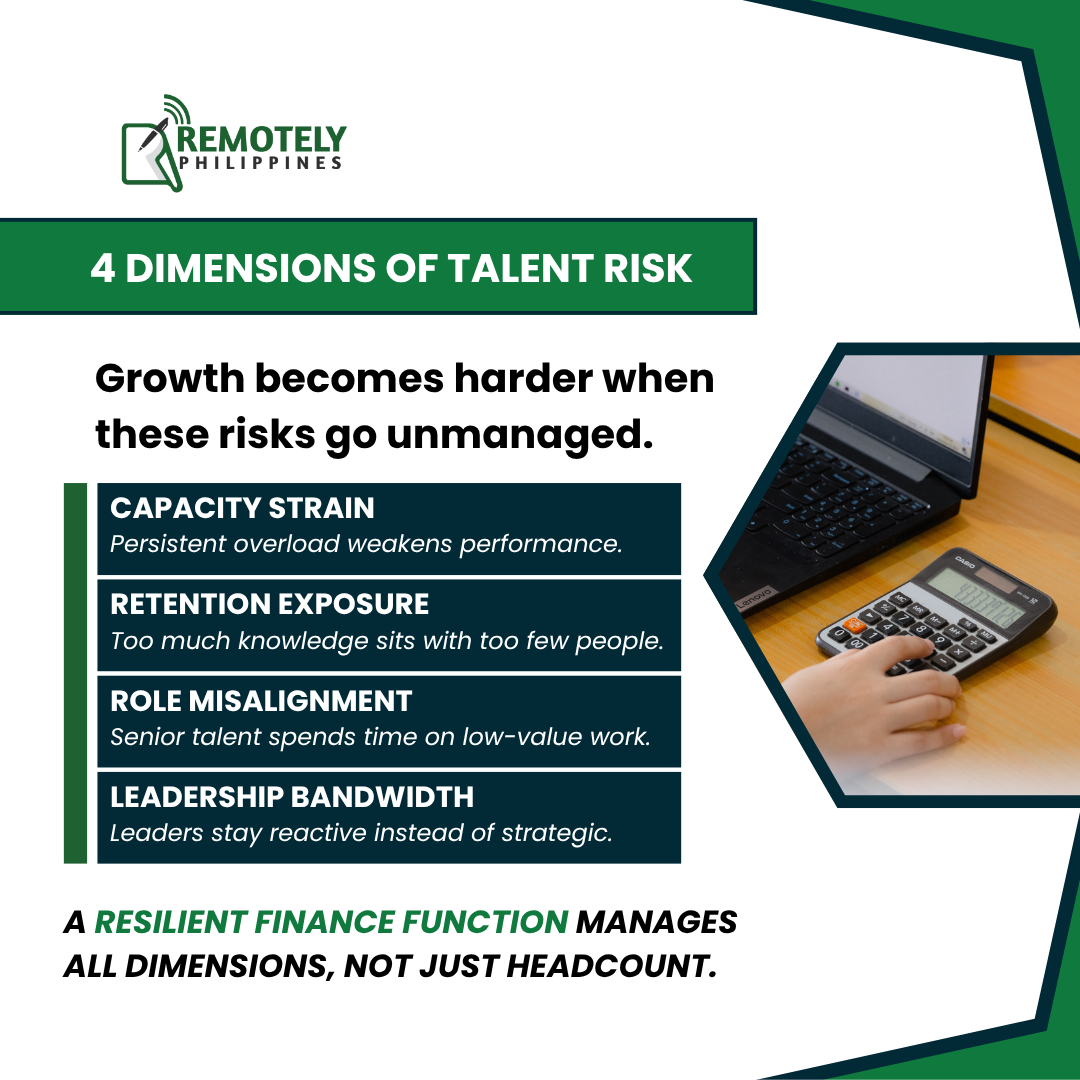
The first is capacity strain.
A busy period is expected in finance. Constant overload is not. When overtime becomes routine, review queues continue to grow, and improvement projects are repeatedly postponed. When operational work consistently takes priority, it may indicate that capacity is no longer keeping pace with business demands. While teams may continue meeting deadlines, they often do so at the expense of sustainability.
The second dimension is retention exposure.
Organizations sometimes underestimate how much knowledge resides within a small number of experienced professionals. If one controller, manager, or senior accountant holds responsibility for critical processes, client relationships, or system expertise, the organization becomes increasingly dependent on individuals rather than well-designed processes.
Even when turnover remains low, this concentration of knowledge creates unnecessary operational risk.
The third area is role misalignment.
One of the most common inefficiencies in finance occurs when highly experienced professionals spend significant portions of their day completing work that could be standardized, delegated, or automated. Controllers should be strengthening internal controls, supporting executive decisions, and improving financial processes.
Senior accountants should be reviewing complex transactions and mentoring junior staff. When these professionals become consumed by routine preparation work, the organization loses valuable strategic capacity.
The final dimension is leadership bandwidth.
Finance leaders are expected to coach their teams, improve workflows, manage stakeholder expectations, and help drive business performance. Yet many spend most of their time resolving operational bottlenecks rather than leading meaningful improvements.
When leadership becomes fully occupied by execution, innovation slows, employee development suffers, and long-term initiatives are often delayed. Individually, these issues may appear manageable. Together, they provide a clearer picture of how prepared a finance team is to support future growth.
Why Small Operational Challenges Become Larger Talent Risks
Talent risk rarely begins with an employee resignation. More often, it begins with a gradual accumulation of responsibilities.
A new reporting requirement has been introduced. A vacant position remains unfilled for several months. A major system of implementation demands additional attention.
Business growth increases transaction volumes, while expectations from leadership continue to expand. Each change appears manageable on its own. Collectively, however, they place increasing pressure on the finance function. As workloads grow, leaders naturally focus on maintaining day-to-day operations.
Strategic initiatives are postponed, documentation becomes outdated, process improvements lose momentum, and coaching conversations happen less frequently. These changes occur gradually. Organizations often adapt without recognizing how much their operating model has shifted.
By the time warning signs become obvious, finance leaders may already be dealing with declining engagement, increased rework, delayed projects, or unexpected turnover. A structured Talent Risk Scorecard helps bring these hidden pressures into the open before they begin affecting performance.
Turning Assessment into Action:
A 45-Minute Leadership Discussion
Completing a scorecard is only the beginning. Its greatest value comes from the conversations it encourages. Controllers, CFOs, and finance managers can use the assessment as the foundation for a focused 45-minute leadership discussion.

The meeting should begin by reviewing current workload trends rather than isolated incidents:
- Are overtime hours increasing?
- Have review bottlenecks become more common?
- Are senior team members spending more time on operational work than strategic priorities?
Once everyone shares a common understanding of current conditions, the team can evaluate each of the four talent risk dimensions together. Differences in perspective often reveal issues that individual managers may not have noticed on their own.
The conversation should then shift from symptoms to root causes. Instead of asking why employees are busy, leaders should ask why certain work continues to rely on senior staff. It’s where processes consistently slow down and where responsibilities could be redistributed, standardized, automated, or supported through external resources.
The final portion of the discussion should focus on action. Rather than attempting to solve every challenge at once, leadership should identify two or three initiatives that will have the greatest impact over the next quarter. These may include updating standard operating procedures, improving documentation, strengthening cross-training, redesigning review workflows, or exploring outsourced support for repetitive accounting activities.
By repeating this discussion quarterly, finance leaders can monitor changes over time and address emerging risks before they become larger operational challenges.
Frequently Asked Questions (FAQs)
-
1. What is a Talent Risk Scorecard?List Item 1
A Talent Risk Scorecard is a structured assessment that helps finance leaders evaluate workforce-related risks affecting operational performance, scalability, and long-term resilience.
-
2. Who should use a Talent Risk Scorecard?List Item 3
The assessment is designed for CFOs, controllers, finance directors, accounting managers, and business leaders responsible for overseeing finance operations.
-
3. How often should finance teams complete the assessment?List Item 4
Many organizations benefit from conducting the assessment quarterly or after major reporting periods to monitor trends and identify emerging risks.
-
4. Does a high talent risk score automatically mean more hiring is required?
Not necessarily. High scores often indicate opportunities to improve workflows, standardize processes, strengthen documentation, automate repetitive work, or redistribute responsibilities before expanding headcount.
A Scorecard Supports Better Decisions for Leaders
No assessment can solve workforce challenges on its own. What a Talent Risk Scorecard provides is greater visibility into the organizational conditions that influence performance. It encourages leaders to move beyond assumptions and evaluate whether workloads remain sustainable, responsibilities are appropriately aligned, and managers have enough capacity to lead effectively.
In many cases, the solution isn't simply hiring more people. Organizations often achieve meaningful improvements by strengthening processes, redistributing work, investing in automation, improving documentation, or introducing outsourced support for standardized finance activities.
These changes allow internal professionals to focus on higher-value work while building a more resilient operating model. Ultimately, finance leaders who regularly assess talent risk are better positioned to protect institutional knowledge, strengthen employee engagement, and create teams that can grow alongside the business.
Conclusion:
Don't Wait Until Talent Risk Becomes a Business Risk
The strongest finance teams don't wait until someone resigns, burnout affects performance, or month-end closes begin slipping before evaluating the health of their workforce. By the time those warning signs become visible, the underlying issues have often been developing for months or even years.
Capacity strain, role misalignment, leadership bottlenecks, and growing dependence on a handful of key employees rarely appear all at once. They accumulate gradually as workloads increase, priorities shift, and temporary solutions become permanent ways of working.
The challenge is that these risks often remain hidden because the team continues to deliver. Reports are submitted. Deadlines are met. Clients remain satisfied. But maintaining performance through increasing pressure is not the same as building a sustainable finance function.
That's why every controller, finance manager, and CFO should regularly assess not only financial performance but also the health of the team responsible for delivering it. If you don't measure talent risk today, you may only discover it after it has already affected productivity, employee retention, reporting quality, or business continuity.
Our Talent Risk Scorecard for Finance Teams is designed to help you identify those risks before they become costly operational problems. In just one facilitated discussion, your leadership team can evaluate capacity strain, retention exposure, role misalignment, and leadership bandwidth, then prioritize practical actions that strengthen your finance function for the months ahead.
Get a copy of our Talent Risk Scorecard for free today and start the conversation before hidden workforce risks become business risks.
Sign up for our newsletter
Get regular curated content on management, outsourcing, and everything you need to know to stay ahead of the curve.
Newsletter
More Articles