
Read Our Reviews on:


How can accurate financial forecasting help businesses make better decisions and reduce risk?
Financial forecasting is one of the most important tools organizations use to plan growth, manage cash flow, and navigate economic uncertainty. Every business decision involves some degree of financial uncertainty. Whether you’re planning to hire new employees, invest in technology, expand into new markets, or secure financing, the quality of those decisions often depends on how accurately you can anticipate future financial performance.
This is where accurate financial forecasting becomes essential. More than simply predicting future revenue and expenses, financial forecasting provides organizations with the insights needed to make informed decisions, allocate resources effectively, and prepare for potential challenges before they arise.
However, forecasting is only as valuable as the accuracy behind it. Reliable projections are built on quality financial data, realistic assumptions, and continuous performance measurement. When done correctly, financial forecasting becomes a strategic tool that helps businesses navigate uncertainty, improve resilience, and support long-term growth.
In this article, we'll explore why accurate financial forecasting matters, how forecast accuracy strengthens business planning, and practical ways organizations can improve the reliability of their financial projections.
Key Takeaways
- Accurate financial forecasting supports better business decisions by providing data-driven insights.
- Reliable financial data is the foundation of effective forecasting and strategic planning.
- Forecast accuracy helps organizations identify performance gaps and improve future forecasts.
- Accurate projections enable better resource allocation, cash flow management, and risk mitigation.
- Investors, lenders, and stakeholders rely on dependable forecasts when assessing business performance and growth potential.
- Continuous improvements in data quality, technology, and forecasting processes strengthen financial resilience.
The Foundation of Reliable Financial Forecasting
Effective financial forecasting is about more than predicting future results. It requires accurate financial data, realistic assumptions, and ongoing measurement of actual performance. While forecasts provide valuable guidance, they remain estimates that can be influenced by market changes, unexpected events, and human judgment.
Even the most sophisticated forecasting models cannot eliminate uncertainty, but they can significantly improve decision-making by reducing guesswork and highlighting potential outcomes. This is why forecast accuracy plays a critical role in the forecasting process.
By comparing projected outcomes with actual results, organizations can identify performance gaps, validate assumptions, and make timely adjustments. Accurate measurement creates a feedback loop that continuously improves forecasting quality and supports better decision-making.
Ultimately, a forecast is only as reliable as the data and measurement systems behind it. When organizations prioritize accuracy, forecasting evolves from a simple planning exercise into a strategic capability that supports sustainable growth.
Understanding Forecast Accuracy in Financial Forecasting
Forecast accuracy refers to how closely forecasted figures align with actual business results. Organizations evaluate this through variance analysis, which compares projected performance against real-world outcomes.
A small variance generally indicates that forecasting assumptions were reasonable and that the forecast can be trusted as a decision-making tool. Large variances, on the other hand, may reveal weaknesses in data quality, forecasting methods, or business assumptions.
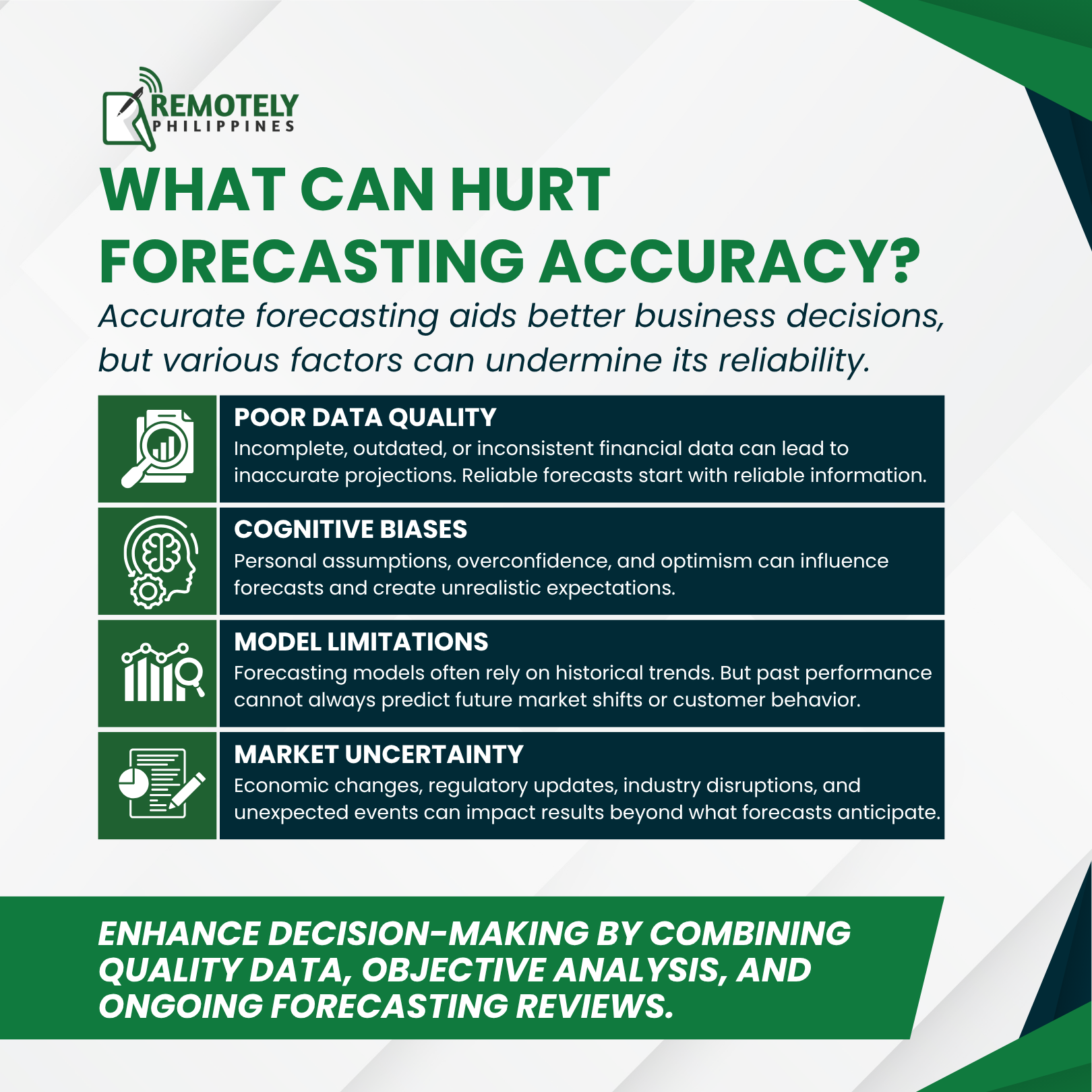
Several factors can negatively affect forecasting accuracy:
- Poor Data Quality
Incomplete, outdated, or inconsistent financial records can undermine the entire forecasting process. Reliable forecasts require reliable data. - Cognitive Biases
Decision-makers may unknowingly rely on outdated assumptions or allow optimism and personal expectations to influence projections.
- Model Limitations
Forecasting models often depend on historical trends. While historical data provides valuable insights, it cannot always predict future market disruptions or changing customer behavior.
- Market Uncertainty
Economic shifts, regulatory changes, competitive pressures, and unexpected events can affect business performance in ways that no forecast can fully anticipate.
Recognizing these challenges helps organizations develop more realistic expectations and create forecasting processes that are flexible enough to adapt to changing conditions.
Strategic Clarity Through Accurate Projections
Accurate financial projections provide organizations with the clarity needed to make confident strategic decisions.
When leaders have a realistic view of future financial performance, they can allocate resources more effectively, avoiding both overinvestment and missed opportunities.
Accurate forecasting supports informed decisions about hiring, inventory management, capital expenditures, and growth initiatives. Reliable projections also help organizations establish realistic goals. Instead of relying on assumptions or overly optimistic expectations, businesses can set targets based on actual financial trends and operational capabilities.
Variance analysis further strengthens strategic planning by highlighting differences between projected and actual performance, allowing management to identify trends, improve forecasting assumptions, and take corrective action sooner. These insights help organizations identify areas requiring attention and adjust strategies before small issues become significant problems.
Additionally, accurate forecasting encourages better alignment across departments. Through integrated planning, teams in finance, operations, human resources, and sales can work from a shared set of assumptions and objectives. This collaborative approach reduces silos and improves organizational efficiency.
By providing a clearer picture of future opportunities and challenges, accurate projections become a cornerstone of effective strategic planning.
Risk Mitigation Through Precision
One of the most valuable benefits of accurate financial forecasting is its ability to help organizations manage risk proactively. Reliable forecasts enable businesses to identify potential cash flow challenges before they become critical. By analyzing financial trends and monitoring projected inflows and outflows, leaders can take corrective action early rather than reacting to problems after they occur.
Accurate trend analysis also strengthens risk management. By incorporating market indicators, economic conditions, and industry developments into forecasting models, organizations can identify potential threats and opportunities sooner.

Scenario planning further enhances financial resilience by allowing organizations to evaluate best-case, expected-case, and worst-case outcomes before critical decisions are made. Rather than relying on a single forecast, businesses can evaluate multiple possible outcomes and prepare contingency plans for different situations.
This allows leaders to assess potential risks and develop strategies to respond effectively. Over time, organizations that continuously measure forecasting accuracy and refine their assumptions become better equipped to navigate uncertainty. This ongoing improvement process creates greater financial stability and strengthens resilience during periods of economic volatility.
Building Stakeholder Confidence
Accurate financial forecasting is not only important for internal decision-making. It also plays a critical role in building confidence among external stakeholders. Investors, lenders, board members, and other stakeholders rely on financial projections to evaluate business performance, growth potential, and risk exposure.
For lenders, accurate cash flow forecasts demonstrate a company's ability to meet financial obligations and manage debt responsibly. Investors examine revenue projections, profitability trends, and growth assumptions when assessing scalability and long-term viability.
Reliable forecasting also reflects positively on management. When financial projections are supported by credible data and sound analysis, stakeholders gain confidence in leadership's ability to make informed decisions and manage resources effectively.
Organizations that regularly stress-test forecasts against different scenarios further strengthen stakeholder trust by demonstrating preparedness for changing market conditions. During due diligence processes, inconsistencies in financial reporting or unsupported forecasting assumptions can raise concerns and potentially jeopardize funding, acquisition, or investment opportunities.
Conversely, accurate and transparent forecasting enhances credibility and positions the organization as a trustworthy partner. Ultimately, reliable financial projections help build lasting stakeholder relationships and support access to capital needed for future growth.
Practical Approaches to Improving Forecast Accuracy
Improving forecasting accuracy requires a combination of strong processes, reliable technology, and skilled professionals.
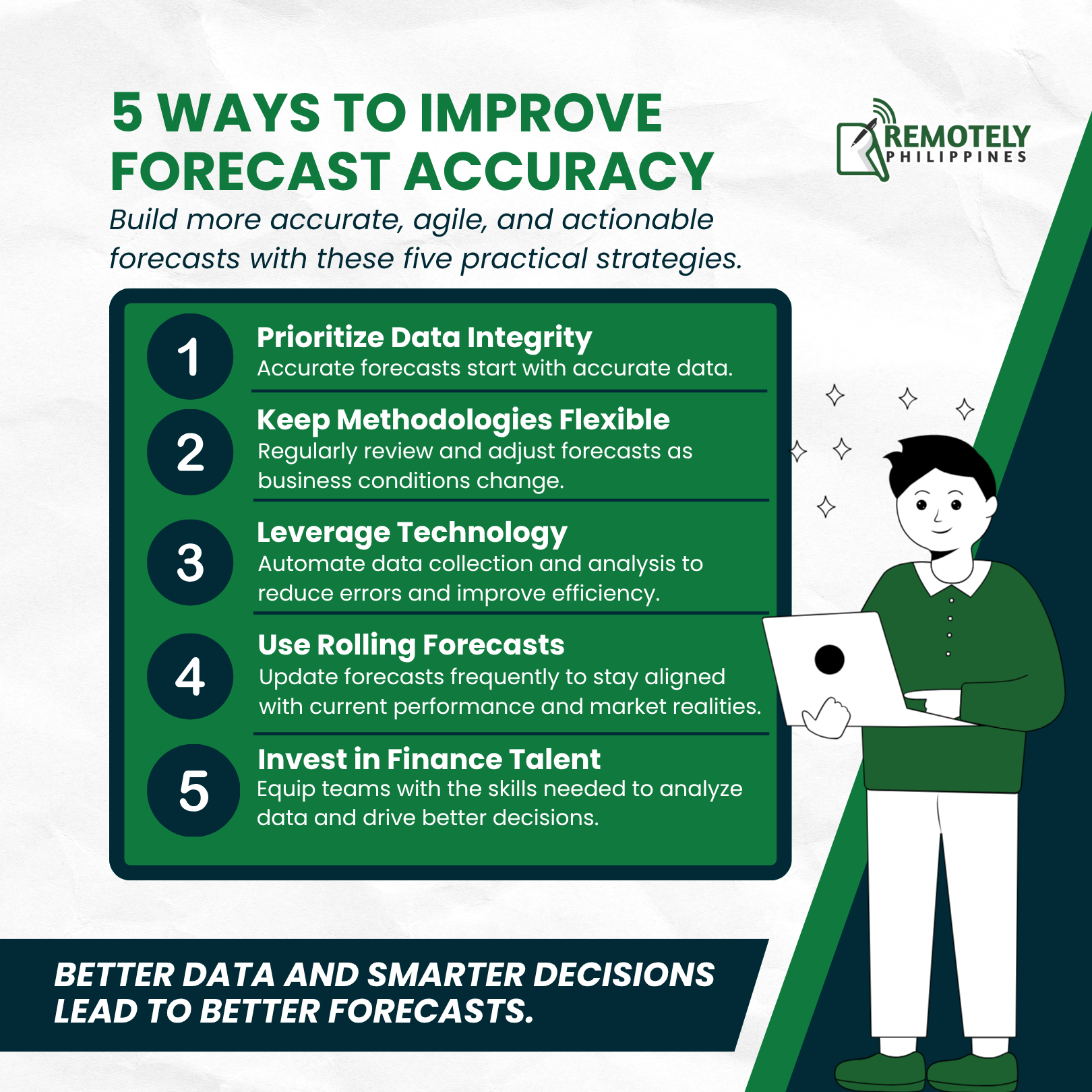
- Prioritize Data Integrity
Forecasts begin with data. Organizations should establish processes to verify financial information, eliminate inconsistencies, and maintain accurate records. A strong data foundation significantly improves forecasting reliability.
- Keep Forecasting Methodologies Flexible
Business conditions evolve constantly. Forecasting models should be reviewed regularly and adjusted based on actual performance and changing market realities. Continuous refinement helps forecasts remain relevant and actionable.
- Leverage Technology
Modern financial tools can automate data collection, reporting, and analysis, reducing manual errors and improving efficiency. Automation allows finance teams to spend more time interpreting insights and less time gathering information.
- Incorporate Rolling Forecasts
Organizations should supplement annual budgets with rolling forecasts that are updated regularly based on current performance and market conditions. Rolling forecasts improve agility and help management respond more effectively to changing business environments.
- Invest in Finance Talent and Training
Technology alone cannot guarantee forecasting success. Organizations should invest in ongoing training and development to strengthen analytical capabilities and foster a culture of continuous improvement.
When businesses focus on data quality, methodology, technology, and talent, they create forecasting processes that support more confident decision-making and long-term success.
Frequently Asked Questions (FAQs)
-
1. What is financial forecasting?List Item 1
Financial forecasting is the process of estimating future financial performance using historical data, current business trends, and market conditions. It helps organizations anticipate revenue, expenses, cash flow, and potential risks.
-
2. Why is accurate financial forecasting important?List Item 3
Accurate forecasting enables organizations to make informed decisions, manage resources effectively, identify risks early, and prepare for changing business conditions.
-
3. How does forecasting help reduce business risk?List Item 4
Forecasting helps organizations anticipate cash flow issues, evaluate different scenarios, identify potential challenges, and develop contingency plans before problems arise.
-
4. What affects forecast accuracy?
Forecast accuracy can be influenced by data quality, forecasting methodology, market volatility, economic conditions, organizational bias, and unexpected external events.
-
5. How often should financial forecasts be updated?
Most organizations benefit from reviewing and updating forecasts monthly or quarterly. Regular updates ensure forecasts remain aligned with actual business performance and changing market conditions.
-
6. Can technology improve financial forecasting?
Yes. Modern financial planning and analysis tools can automate data collection, reduce errors, improve reporting accuracy, and provide real-time insights that support better decision-making.
Conclusion
Accurate financial forecasting is far more than a budgeting exercise. It is a strategic capability that helps organizations make informed decisions, allocate resources effectively, and navigate uncertainty with confidence. When forecasting is supported by reliable data, rigorous measurement, and continuous improvement, businesses gain greater visibility into future opportunities and risks.
This clarity enables leaders to respond proactively to changing conditions, strengthen financial resilience, and pursue growth with greater confidence. Achieving lasting forecasting accuracy requires more than sophisticated models and technology.
It also depends on fostering a culture of accountability, transparency, and collaboration across the organization. When financial planning reflects both accurate data and operational realities, forecasting becomes a powerful tool for sustainable success.
As today’s business environment becomes increasingly complex, organizations that prioritize accurate financial forecasting will be better positioned to adapt, compete, manage risk, and capitalize on opportunities with confidence in the years ahead.
Sign up for our newsletter
Get regular curated content on management, outsourcing, and everything you need to know to stay ahead of the curve.
Newsletter
More Articles