Read Our Reviews on:


What steps can taxpayers and preparers take to prevent tax filing errors before submission?
Taxpayers often make simple mistakes that can lead to rejected returns and delayed refunds. For example, the IRS National Taxpayer Advocate reports that nearly 18 million e-filed individual returns were rejected in FY2024 for basic issues like mismatched Social Security numbers, name spelling errors, or missing forms.
In 2025, the IRS processed over 165 million returns, yet about 3.6 million taxpayers waited beyond the normal processing time for refunds. These errors not only stall refunds but can also incur penalties (e.g., under IRC §§6651, 6662 for late or incorrect filings) and raise audit risk. A systematic quality control approach – reviewing and verifying every part of the return before filing – helps catch errors early.
This post reviews common IRS-reported mistakes and outlines QC best practices (including a sample checklist) so that individuals, small businesses, and expats can file more confidently and avoid IRS rejections.
Key Takeaways
- Many rejected tax returns result from simple data entry errors, such as mismatched SSNs or missing forms.
- Identity verification issues, especially incorrect prior-year AGI entries, are a leading cause of e-file rejection.
- Reporting all income sources and attaching required documentation is essential for accurate processing.
- Eligibility for tax credits and deductions must be verified carefully before filing.
- A structured quality control process helps detect errors before submission and reduces delays.
Errors in tax returns can have real consequences. A rejected e-file is not filed – a taxpayer must fix the issue and resubmit, risking missed deadlines. In 2025, 3.6 million e-filers waited an average of 7 weeks (14 weeks for paper filers) beyond the normal refund time.
Mistakes like math miscalculations or omitting tax due can also trigger interest charges and accuracy-related penalties under IRS rules. Quality control (QC) is the process that tax professionals use to minimize these mistakes. It involves checklists, multiple reviews, and verification of data against source documents.
By double-checking names, numbers, and forms before submission, filers reduce the chance of IRS rejection and help ensure a smooth filing. The sections below outline common filing errors to avoid and key QC steps to implement a thorough review process.
Common Tax Filing Errors to Avoid
According to IRS guidance, many simple errors cause returns to be rejected. Below are categories of frequent mistakes, based on IRS reports and reject code analyses:
- Personal information errors: Enter names, Social Security Numbers (SSNs), and addresses exactly as on official records. Typos or transposed digits in SSNs/ITINs will reject an e-filed return. Always copy names and SSNs from Social Security cards. Mismatched addresses or ZIP codes (for example, if moving or using an old address) can delay IRS mailings. Even minor misspellings of the taxpayer's or spouse's name are a reject trigger.
- Filing status mistakes: Choose only one correct filing status box (Single, Married Filing Jointly, etc.). Selecting the wrong status (e.g., “Head of Household” when married) or checking multiple boxes will cause an error. The IRS will reject e-filed returns with invalid status selections. Review eligibility rules if unsure; for example, a married person living with their spouse must generally file jointly or separately, not as single/HOH.
- Math and calculation errors: On paper returns, double-check all math. Ensure totals, tax tables, and credits are calculated correctly. IRS Topic 303 advises using the correct column in the tax tables for your filing status and putting parentheses around negative amounts. E-filed returns eliminate most math errors, but if preparing manually, verify: re-add column totals, recalc the tax, and confirm refundable credit figures. Even small math slips can change the refund or balance due and trigger a notice.
- Income reporting issues: Report all income and attach the required forms. For example, include every Form W-2 from each employer, combining multiple jobs on one return. Attach Copy B of each W-2. Also include all 1099 forms you received – 1099-NEC, 1099-MISC, 1099-K, 1099-INT, 1099-DIV, 1099-R, etc.
Failing to include a 1099 (e.g., from freelance work or bank interest) can delay processing or cause an adjustment later. The IRS matches W-2 and 1099 data to filed returns, so underreporting income (intentionally or by oversight) will usually be caught. If you have business or rental income, ensure Schedule C or E is filled out, and net profits are reported correctly.
- Credits and deductions errors: Verify eligibility and calculations for credits. Common pitfalls include claiming credits for ineligible dependents or miscalculating amounts. For instance, the IRS warns not to claim the Earned Income Tax Credit (EITC) for a child who doesn’t meet all qualifying tests.
Also check Social Security Numbers for all children; EITC and Child Tax Credit (CTC) require each qualifying child to have a valid SSN issued before the due date[9]. Do not claim the CTC/ACTC unless each child is under 17 (age requirement) and has the proper SSN.
If you received an advance premium tax credit (APTC) through the ACA marketplace, you must attach Form 8962 (Premium Tax Credit); otherwise, the IRS will reject your e-file. Similarly, certain deductions (student loan interest, retirement contributions, education credits) require attaching the appropriate form or statement and meeting income limits. In short, ensure that any credit or deduction claimed is supported by the rules, and attach all necessary forms.
- Identity verification (AGI/PIN) problems: The IRS uses prior-year data to verify identity. When e-filing, you must enter last year’s Adjusted Gross Income (AGI) or Self-Select PIN from your prior return. According to the Taxpayer Advocate, the single most frequent e-file rejection reason is a mismatch of AGI or prior-year PIN.
If you recently filed an amended return (1040X) or have a new tax return, special instructions apply (e.g., entering “0” for AGI, or obtaining a verification code). Also, if you received an IRS Identity Protection PIN (IP PIN), include it with your return. If you skip these identity checks, the IRS will reject the return.
- Other frequent reject triggers: Watch for duplicate filings and dependent conflicts. If someone else (like an ex-spouse or former guardian) already claimed your dependent or yourself, the IRS will generate a duplicate-SSN rejection. Similarly, filing more than one return with the same Social Security Number (even if with different statuses) will be flagged.
The IRS also rejects returns with invalid IP PINs (perhaps copied incorrectly) or mismatched birth dates. As the NTA report notes, other common e-file rejects involve “duplicate filings” and “name mismatches”. Finally, ensure your bank account routing and account numbers are correct if you use direct deposit; mistakes here can lead to rejected refunds or slow re-issuance.
- Similar issues arise in other countries’ systems. For example, Australian taxpayers must accurately report foreign income and meet residency requirements under ATO rules, and UK filers must follow HMRC’s self-assessment guidelines (residency tests, double taxation treaties, etc.). In all systems, the key is accurate data entry and eligibility checking.
Building Effective Quality Control for Tax Files

A strong quality control process in tax preparation means systematic review at multiple stages. First, document collection is critical: gather all W-2s, 1099s, receipts, and statements before starting. Match each form to your records. Using tax software can help track missing documents. Next, initial preparation should follow a checklist – enter data carefully from source documents, and let the software flag missing fields.
Quality control often involves a “two-person” review. For instance, one person (or spouse) prepares the return, and a second person (another preparer or partner) goes through it line-by-line. This second review checks every entry: ensuring names/SSNs match IDs, confirming all W-2 and 1099 forms are included, and verifying that income and deduction lines correctly reflect the paperwork.
Software diagnostics will catch many basic errors (omitted forms, math mismatches, invalid SSNs), but manual cross-checks are still needed for judgment calls – e.g. confirming a dependent qualifies for child credits. Quality control may also include comparing this year’s draft return to last year’s: large unexpected changes in income or deductions should be verified. Always finalize by confirming the form is signed and dated (and spouse’s signature if joint).
For U.S. expats and international filers, add extra steps: check foreign income, currency conversions, and reporting forms. Make sure any foreign tax credits (Form 1116) or exclusions (Form 2555) are calculated correctly, and that you comply with FBAR/FACTA (FinCEN Form 114) if you have foreign accounts. It helps to consult expat tax resources [link to blog on expat taxes] and relevant IRS guidance.
Sample Tax File Quality Control Checklist
Below is a sample QC checklist covering key review points. Modify it to fit your situation:
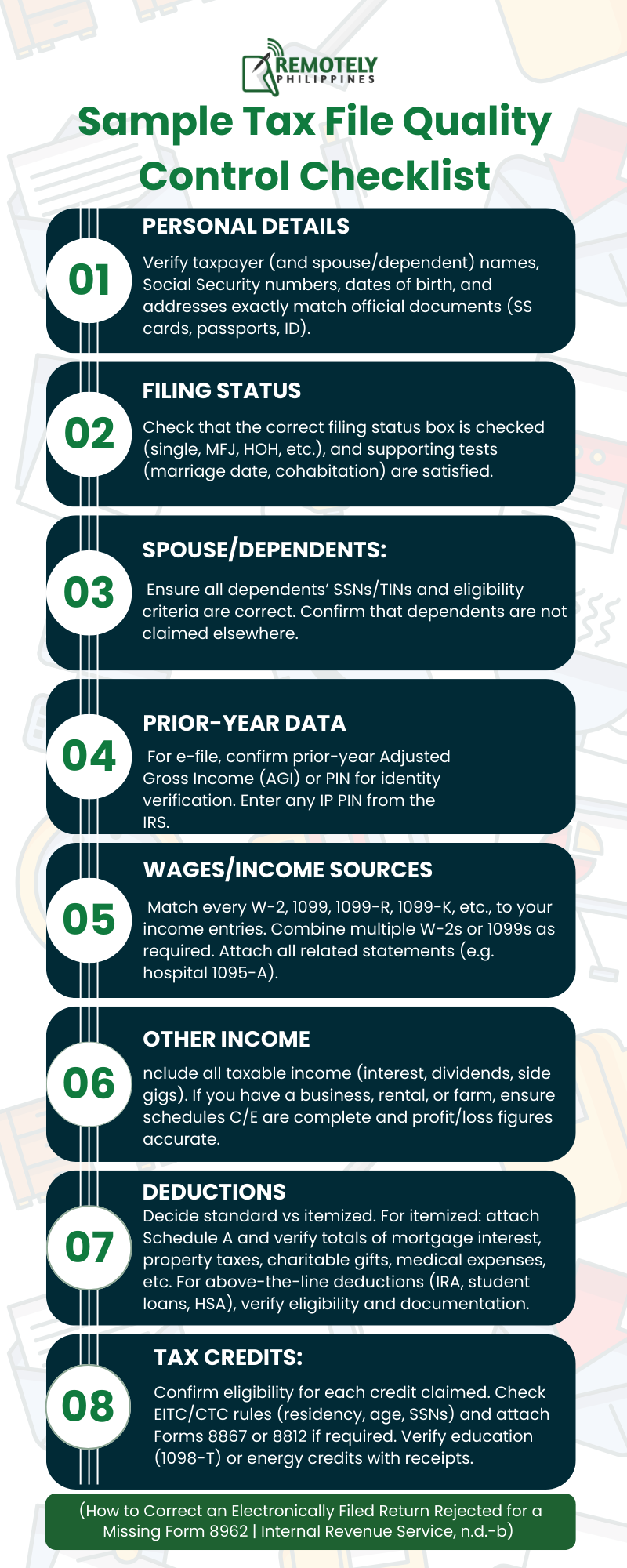
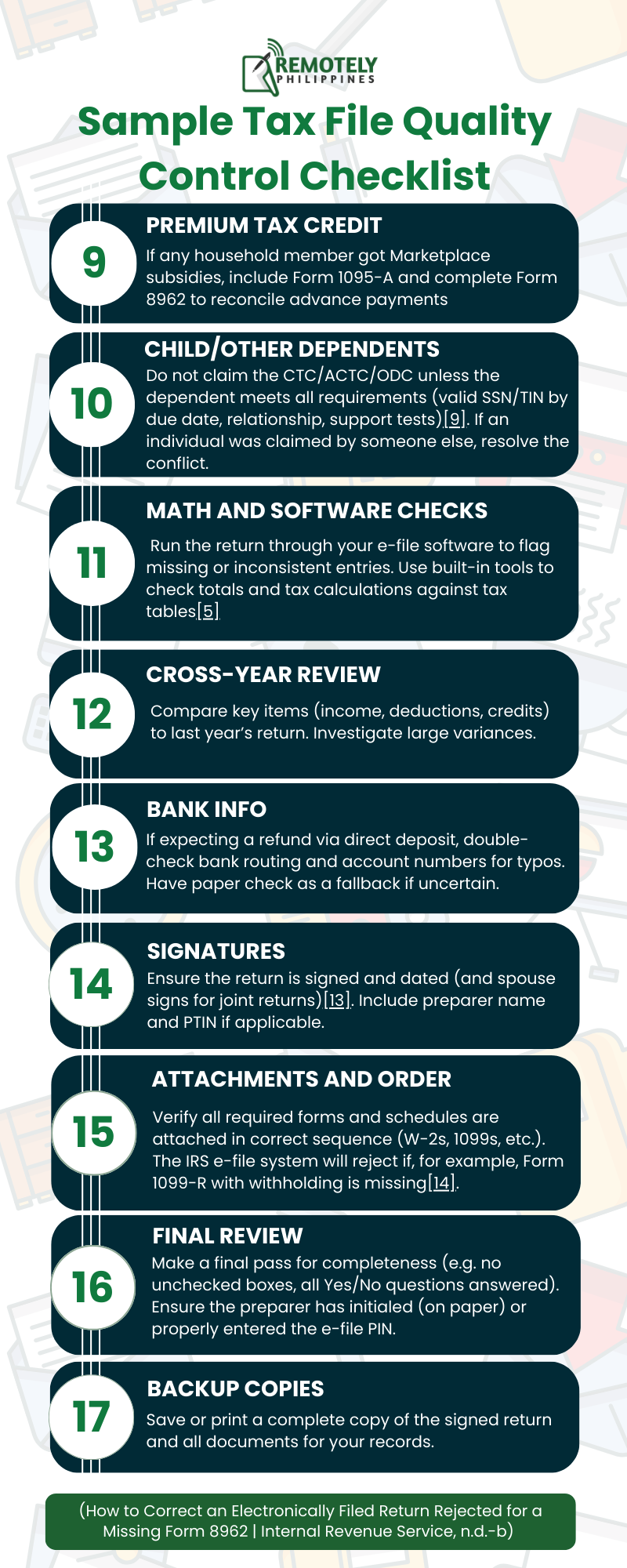
Using a checklist like this helps catch errors systematically. Many firms do a “warm review” (immediate check after preparation) and a “cold review” (with fresh eyes before filing). Individuals can mirror this by reviewing returns after a short break.
Conclusion
Careful review and quality control are essential for accurate tax filing. By verifying personal information, confirming income and credit entries, and ensuring that required forms such as W-2s, 1099s, and Form 8962 are included, taxpayers can avoid many of the issues that trigger IRS rejections.
Following a consistent quality control checklist and performing multiple review stages can significantly reduce processing delays, lower the risk of penalties, and help ensure that refunds are issued more quickly.
More importantly, a structured QC process builds confidence in the accuracy of the return. Whether preparing taxes individually or as part of a professional practice, establishing disciplined review procedures helps minimize errors, improve compliance, and create a smoother filing experience.
In an increasingly automated tax environment where returns are validated quickly by IRS systems, attention to detail remains critical. Taking the time to review each component of a return before submission can prevent costly corrections later and ensure filings are completed the first time accurately.
FAQs
List of Services
-
1. What is quality control in tax preparation?List Item 1
Quality control in tax preparation refers to the systematic process of reviewing a tax return to verify that all data entries, calculations, and supporting documents are accurate before submission.
-
2. Why do tax returns get rejected by the IRS?List Item 3
Returns are commonly rejected due to mismatched Social Security numbers, incorrect prior-year AGI entries, duplicate filings, missing forms, or identity verification errors.
-
3. Does e-filing eliminate filing errors?List Item 4
E-filing reduces math and calculation mistakes but does not prevent issues related to missing documents, eligibility errors, or incorrect personal information.
-
4. Why is a second review recommended for tax returns?
A second review allows another individual to verify the return line-by-line, helping identify overlooked errors or missing information before submission.
-
5. How can taxpayers reduce filing errors?
Taxpayers can reduce errors by gathering documents early, verifying personal details, reviewing calculations, and using a standardized quality control checklist.
Sign up for our newsletter
Get regular curated content on management, outsourcing, and everything you need to know to stay ahead of the curve.
Newsletter
More Articles