

Read Our Reviews on:


A successful year-end close is rarely determined by what happens in December alone. More often, it reflects the quality of decisions, controls, and execution throughout the year.
By the end of Q3, finance leaders have a valuable opportunity to assess whether recurring issues have been resolved, critical projects are on track, and the finance function is prepared for the increased demands that accompany year-end reporting.
Organizations that use this period to pause, reflect, and realign are often better positioned to avoid last-minute surprises, audit disruptions, and report delays. This is where a focused finance retrospective becomes particularly valuable. A Q3 retrospective is not meant to revisit every challenge encountered during the year.
Instead, it is a structured review designed to identify recurring exceptions, assess unfinished work, and confirm the actions required to support a successful year-end close.
Key Takeaways
- Q3 provides the ideal opportunity to assess year-end readiness before December close pressures intensify.
- A 45-minute retrospective can uncover recurring issues that affect reporting quality, efficiency, and control effectiveness.
- Focus the discussion on exception trends, unfinished work, and agreed actions.
- Prioritize outstanding activities according to year-end reporting risk.
- Assign clear ownership, deadlines, and accountability for every action item.
- Use retrospective findings to strengthen close management and improve audit readiness.
- Continuous improvement throughout the year is one of the strongest predictors of a successful year-end close.
The approach aligns with guidance from the International Federation of Accountants (IFAC), which emphasizes that modern finance functions should move beyond transactional reporting and play a broader role in performance management, enterprise risk management, and organizational decision-making.
In many organizations, a well-structured 45-minute review is enough to surface critical risks, strengthen accountability, and improve year-end preparedness.
Why Q4 Is the Right Time to Take Stock
The fourth quarter represents a practical checkpoint between business-as-usual operations and the heightened pressure of year-end reporting.
By this stage, finance teams have typically completed nine months of closes, forecasts, reconciliations, budget reviews, and management reporting cycles. That body of work provides sufficient evidence to identify meaningful patterns rather than isolated incidents.
Unlike a month-end review, a Q4 retrospective allows finance leaders to evaluate performance across multiple reporting cycles and determine whether recurring issues are being addressed effectively. It provides an opportunity to step back from daily responsibilities and assess the broader health of finance operations before year-end deadlines begin to accelerate.
A Q4 retrospective also shifts the conversation from what happened during the quarter to what could affect the success of the year-end close. Unresolved reconciliation issues, delayed projects, recurring control deficiencies, and resource constraints may appear manageable today, but they often become more disruptive when audit requests, reporting deadlines, and compliance obligations converge in December.
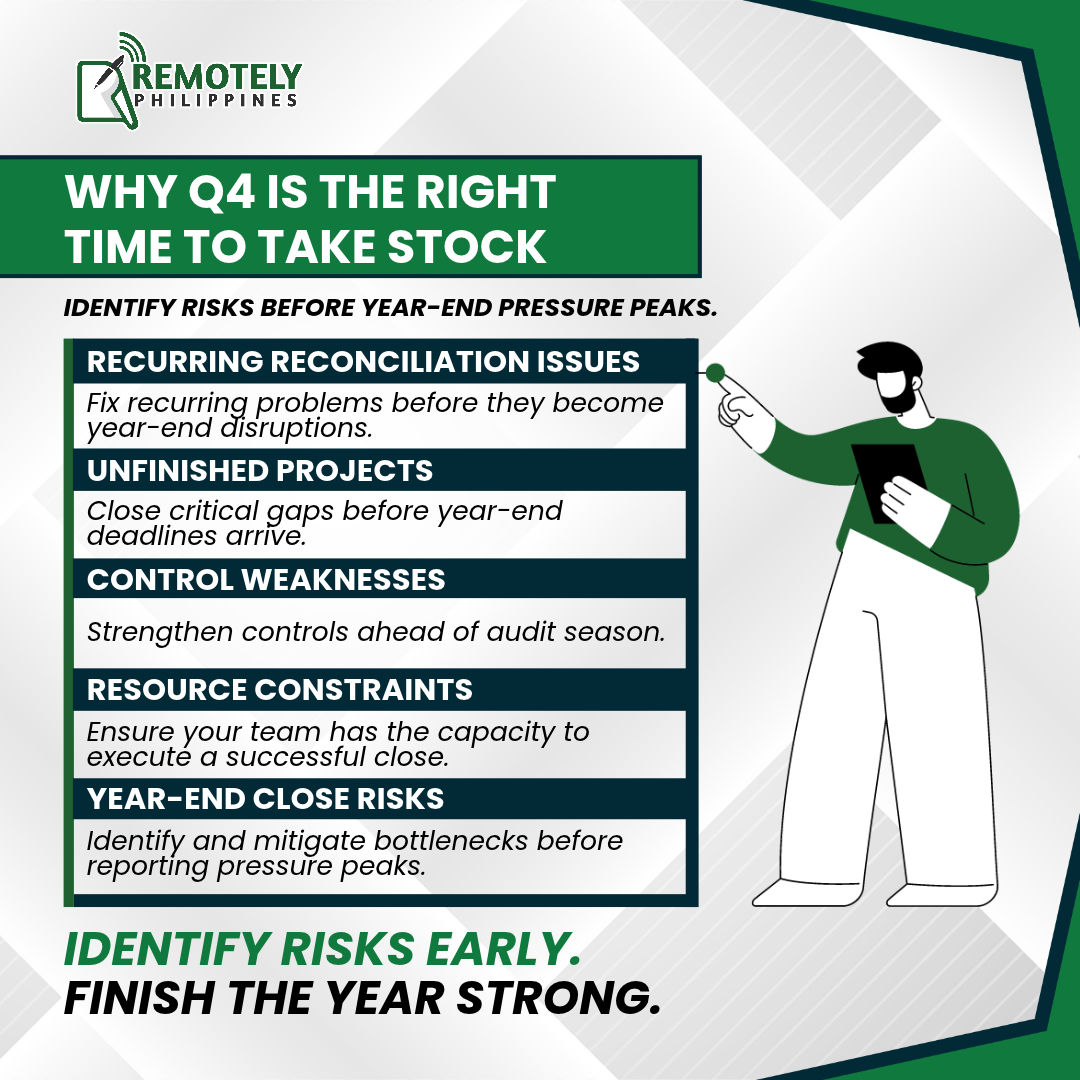
A structured review enables finance leadership to answer important questions:
- Which issues have surfaced repeatedly this year?
- What projects remain incomplete?
- Which unresolved items could create risks during year-end close activities?
- Are control weaknesses being addressed effectively?
- Does the team have the resources and capacity required to execute a successful December close?
According to IFAC's Evaluating the Finance Function framework, high-performing finance organizations create value not only through accurate reporting, but also through actionable insights, performance analysis, enterprise risk management, effective communication, trust, and professional integrity.
The framework emphasizes the importance of regularly evaluating how effectively the finance function supports organizational objectives and where improvements may be needed. A structured Q4 retrospective supports that objective by helping leaders identify operational gaps, prioritize corrective actions, and focus resources on the areas that will have the greatest impact before year-end.
Three Questions Every Finance Team Should Review
An effective retrospective can be organized around three simple but highly practical questions. Together, they help finance leaders identify recurring operational issues, prioritize unfinished work, and focus resources on the activities that will have the greatest impact on year-end readiness.
1. What exception trends continue to appear?
Recurring problems deserve attention. While isolated errors may be unavoidable, issues that repeatedly emerge across multiple reporting cycles often indicate deeper challenges within finance operations.
These may include process weaknesses, documentation gaps, unclear ownership, inadequate controls, technology limitations, or resource constraints. Rather than treating each exception as a separate incident, finance leaders should look for patterns.
A recurring reconciliation delay, recurring journal entry correction, or repeated forecasting variance may point to a root cause that affects multiple areas of the finance function. Addressing those underlying issues can reduce manual effort, improve reporting accuracy, and strengthen the efficiency of future close cycles.
2. What important work remains unfinished?
Open projects can become year-end obstacles if not appropriately prioritized. By Q4, many finance teams are balancing routine responsibilities alongside process improvement initiatives, remediation efforts, system updates, audit preparation activities, and strategic projects.
Not all unfinished work carries the same level of risk, making prioritization essential.
The retrospective should identify which outstanding initiatives are critical to reporting accuracy, compliance, audit readiness, or operational continuity, and which can reasonably be deferred until the following fiscal year. Taking a risk-based approach helps ensure that limited time and resources are focused on activities that matter most before year-end.
3. What actions must be completed before year-end?
The meeting should conclude with clear commitments, assigned ownership, and defined timelines. A retrospective creates value only when observations lead to action. Identifying issues is an important first step, but meaningful improvement depends on execution and accountability. Every significant finding should result in a documented action plan that outlines what needs to be done, who is responsible, and when progress should be reviewed.

Without ownership and follow-through, even the most valuable insights are unlikely to translate into measurable improvements. Establishing accountability during Q4 increases the likelihood that critical issues will be resolved before year-end reporting demands begin to intensify.
The First 15 Minutes: Review Exception Trends
The opening portion of the retrospective should focus on patterns rather than individual incidents. Finance teams often spend significant time correcting issues as they arise without stepping back to understand why those same issues continue to recur.
While individual exceptions may seem manageable in isolation, recurring problems can signal deeper operational challenges that affect efficiency, reporting accuracy, and control effectiveness.
The goal of this discussion is not to produce a catalog of every exception encountered during the year. Instead, it is to identify trends that repeatedly consume time, require manual intervention, create unnecessary risk, or delay critical finance activities.
Common areas worth reviewing include:
- Account reconciliation delays
- Repeated journal entry corrections
- Forecasting variances
- Revenue recognition adjustments
- Payroll discrepancies
- Delayed invoicing activity
- Recurring accrual adjustments
- Internal control deficiencies
- Repeat audit observations
Recurring exceptions often point to underlying issues such as process inefficiencies, documentation gaps, unclear ownership, inadequate controls, technology limitations, or resource constraints. When these root causes remain unresolved, the same problems tend to reappear across reporting cycles, creating additional workload and increasing the risk of year-end disruptions.
Consider a reconciliation process that routinely misses deadlines. At first glance, the issue may appear to be workload-related. A deeper review may reveal that the underlying challenge stems from inconsistent source data, poorly defined responsibilities, inadequate documentation, or excessive manual intervention.
Addressing those root causes is far more effective than simply working longer hours to meet deadlines each month. Those distinctions matter. The most effective corrective actions address underlying causes rather than recurring symptoms. Organizations that consistently improve close performance focus on eliminating sources of friction instead of repeatedly managing the consequences.
This approach also supports a broader objective recognized by APQC: reducing time spent managing recurring close-related issues allows finance teams to devote more attention to decision support, operational improvement, and strategic initiatives.

Questions to Ask During This Stage
As recurring issues are reviewed, finance leaders should look beyond the exception itself and evaluate its broader impact on the finance function and year-end readiness.
- What exceptions appeared most frequently?
- Have corrective actions been effective?
- Are issues concentrated within specific processes or teams?
- What would happen if the problem remained unresolved during year-end close?
- Are there opportunities to simplify, standardize, or automate the process?
The answers often reveal improvement opportunities that can still be addressed before December. More importantly, they help finance leaders distinguish between isolated operational challenges and systemic issues that could create meaningful disruption during year-end close.
The Next 15 Minutes: Evaluate Unfinished Work
The second portion of the retrospective should focus on open initiatives, unresolved issues, and incomplete projects. By Q4, many finance departments are balancing routine close responsibilities alongside process improvements, audit preparation, compliance activities, and strategic initiatives that have accumulated throughout the year.
Not every outstanding item requires completion before year-end. However, some projects directly affect reporting accuracy, close timelines, audit readiness, or regulatory compliance. Identifying these priorities early helps ensure that limited resources are directed toward activities with the greatest potential impact on year-end success.
Examples include:
- Outstanding balance sheet reconciliations
- Unresolved intercompany balances
- Fixed asset clean-up projects
- Deferred revenue reviews
- Tax reconciliations
- Control remediation plans
- ERP enhancement initiatives
- Audit recommendation follow-ups
- Reporting standardization projects
These activities align closely with several components of the financial close process identified by APQC, including account reconciliations, journal entries, period-end adjustments, and intercompany transaction reviews. Delays in these areas can create additional pressure during year-end close, particularly when reporting deadlines and audit requirements begin to overlap. The objective is not simply to reduce the backlog.
It is to determine which items need immediate attention, which require monitoring, and which can reasonably be deferred until after year-end without creating unnecessary risk.
Categorize Open Items by Risk
A practical approach is to evaluate outstanding work based on its potential impact on financial reporting, compliance obligations, close efficiency, and audit readiness. Risk-based prioritization helps finance leaders avoid spreading teams too thin while ensuring critical issues are addressed before year-end.

High Risk
These activities could impair reporting accuracy, delay close activities, or create audit concerns if left unresolved.
Examples include:
- Material reconciliation issues
- Significant audit findings
- Control deficiencies
- Unresolved accounting judgments
Items in this category should receive immediate attention and active management oversight. The longer these issues remain unresolved, the greater the likelihood that they will disrupt year-end close activities or require significant remediation under tighter deadlines.
Medium Risk
These activities improve operational effectiveness and strengthen finance processes but are less likely to jeopardize reporting timelines directly.
Examples include:
- Process optimization projects
- Reporting enhancements
- Documentation improvements
While these initiatives may not create immediate year-end risks, completing them can still generate efficiency gains and reduce workload over time. Teams should evaluate whether the expected benefits justify competing for limited Q4 resources.
Low Risk
These initiatives provide long-term value but are unlikely to have a significant effect on year-end reporting outcomes.
Examples include:
- Future transformation projects
- Nonessential report redesigns
- Long-term process reviews
Where resource constraints exist, these projects can often be deferred until after year-end close activities are completed. Delaying them may slow longer-term improvements, but it typically poses minimal risk to reporting accuracy or audit readiness.
Risk-based prioritization ensures resources are focused where they can have the greatest impact. More importantly, it helps finance leaders distinguish between work that is important and work that is urgent, allowing teams to enter year-end with greater confidence, stronger controls, and fewer unresolved risks.
The Final 15 Minutes: Confirm Actions and Accountability

Many retrospective meetings generate valuable discussion but relatively little execution. Teams identify recurring issues, agree on priorities, and acknowledge areas for improvement, yet the same challenges often resurface during future reporting cycles.
The difference between a productive retrospective and an unproductive one is not the quality of the discussion. It is whether the discussion leads to clear, measurable actions. For that reason, the final portion of the review should be dedicated entirely to action planning.
The objective is to convert observations into commitments and ensure that critical issues are addressed before year-end reporting activities intensify. For every significant issue identified, finance leaders should document:
- Required action
- Assigned owner
- Due date
- Expected outcome
- Escalation process
This level of detail helps eliminate ambiguity and creates accountability. It also makes it easier to monitor progress, evaluate results, and intervene when critical activities begin to fall behind schedule.
For example:
| Issue | Action | Owner | Deadline |
|---|---|---|---|
| Reconciliation delays | Implement weekly reconciliation reviews | Financial Controller | November 15 |
| Outstanding accruals | Complete account validation and support schedules | Accounting Manager | November 20 |
| Open audit findings | Finalize remediation evidence and documentation | Finance Operations Lead | November 30 |
Notice that each action includes a specific deliverable, an accountable owner, and a target completion date. This structure helps ensure that improvement efforts move beyond good intentions and become part of the team's operating plan.
Effective accountability also aligns with the principles embedded within the COSO Internal Control - Integrated Framework, which identifies clear authority, responsibility, governance, and accountability as essential elements of a strong control environment.
Simply put, actions need owners.
Without clear ownership, critical tasks can easily be delayed as competing priorities emerge throughout Q4. When responsibility is assigned and progress is monitored regularly, organizations are significantly more likely to resolve issues before they affect reporting timelines, audit readiness, or control effectiveness.
The retrospective should therefore end with a clear understanding of who is responsible for what, when key milestones will be completed, and how unresolved issues will be escalated if progress stalls. That discipline often determines whether identified risks are successfully mitigated before year-end or carried forward into the next reporting cycle.
Four Warning Signs That Deserve Immediate Attention
As action items are finalized, finance leaders should also identify any issues that may require accelerated remediation before year-end. While not every open item poses a significant risk, certain patterns often signal deeper operational, control, or governance challenges that can become more disruptive as reporting deadlines approach.
Persistent Close Delays
'
Repeated close delays are rarely just scheduling issues. If close timelines continue to slip despite corrective actions, the underlying cause may stem from inefficient workflows, approval bottlenecks, poor data quality, resource constraints, or excessive manual processes.
Left unaddressed, these issues can become even more pronounced during year-end close when transaction volumes, audit requests, and reporting requirements increase.
Dependence on Key Individuals
A finance process that relies heavily on one person creates unnecessary risk. When critical knowledge, approvals, or procedures reside with a single employee, unexpected absences can disrupt close activities and delay important deliverables.
Reviewing key-person dependencies during Q4 provides an opportunity to strengthen documentation, cross-train team members, and improve business continuity before year-end demands intensify.
Frequent Manual Corrections
Recurring spreadsheet adjustments, manual reconciliations, and repeated journal entry corrections often indicate opportunities to strengthen controls or improve process design.
While some manual intervention will always be necessary, a high volume of recurring corrections may suggest underlying issues with source data, system integration, approval workflows, or process consistency. Reducing reliance on manual work not only improves efficiency but also helps lower the risk of errors during critical reporting periods.
Unresolved Audit Findings
Open audit findings deserve particular attention as year-end approaches. Issues that remain unresolved for extended periods may point to broader control, documentation, or governance weaknesses. They can also create additional scrutiny during future audit reviews and consume valuable management time when teams are already focused on year-end responsibilities.
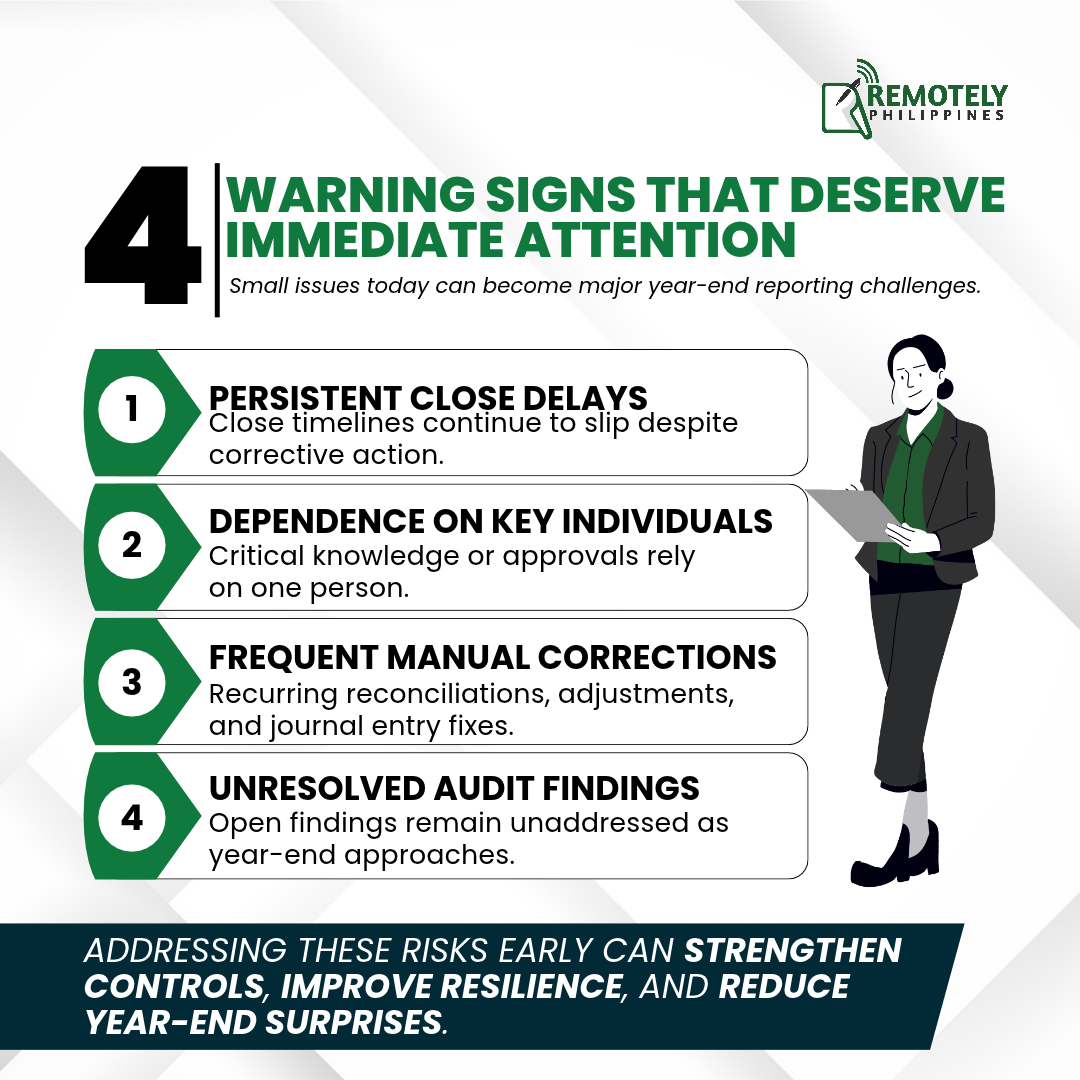
Taken together, these warning signs can help finance leaders identify where additional attention may be needed before the year-end close begins. Addressing them proactively can strengthen control environments, improve operational resilience, and reduce the likelihood of last-minute surprises during the busiest reporting period of the year.
Turning Retrospective Insights into a Year-End Readiness Plan
The ultimate value of a retrospective is not the discussion itself. Its value lies in the actions that follow. By the end of the review, finance leaders should have a clear understanding of which risks require immediate attention, which projects must be completed before year-end, and where resources should be focused during the final weeks of the reporting cycle.
The next step is translating those insights into a practical readiness plan. A year-end readiness plan does not need to be overly complex. Its primary purpose is to reduce uncertainty, strengthen execution, and ensure critical activities are completed before reporting demands intensify.
Key areas of focus typically include:
- Completing critical reconciliations
- Closing material outstanding items
- Reviewing significant accounting estimates
- Validating tax positions and accruals
- Confirming close calendars and timelines
- Assessing audit readiness
- Reviewing staffing coverage plans
- Verifying process ownership
- Addressing outstanding control deficiencies
While every organization will have its own priorities, these activities tend to have a direct impact on reporting accuracy, audit efficiency, and close performance. Delays in any of these areas can create unnecessary pressure when year-end deadlines begin to converge.
The objective is straightforward: eliminate as much uncertainty as possible before year-end reporting activities accelerate. Organizations that enter December with unresolved reconciliations, outstanding audit issues, unclear responsibilities, or resource gaps often find themselves managing avoidable risks under significant time pressure.
In contrast, organizations that proactively address these items during Q4 are better positioned to execute a smoother close, respond to audit requests more efficiently, and devote more time to analysis and business support rather than issue resolution.
A well-executed retrospective should therefore leave finance leaders with more than a list of observations. It should provide a clear roadmap for finishing the year strong and entering the close process with confidence.
Frequently Asked Questions (FAQs)
-
1. What is a finance retrospective?List Item 1
A finance retrospective is a structured review of financial operations, close performance, controls, and reporting processes to identify lessons learned and opportunities for improvement.
-
2. Why should finance teams conduct a Q3 retrospective?List Item 3
Q3 provides sufficient operational history to identify trends while still leaving enough time to address issues before year-end reporting deadlines.
-
3. Who should participate?List Item 4
CFOs, Controllers, Accounting Managers, FP&A leaders, Finance Operations teams, and other stakeholders responsible for the close process should typically participate.
-
4. How long should the review take?
A focused retrospective can be completed in approximately 45 minutes when discussions concentrate on priorities rather than detailed transaction reviews.
-
5. What are the most common issues uncovered?
Recurring reconciliation delays, repeat audit findings, forecasting variances, excessive manual adjustments, and unresolved control issues are among the most common findings.
-
6. How can organizations ensure follow-through?
Assign a single accountable owner for each action item, establish target completion dates, and review progress regularly during Q4.
Building a Culture of Continuous Improvement
The most effective finance teams do not rely on year-end heroics. They build processes, controls, and operating disciplines that support continuous improvement throughout the year. A quarterly retrospective is one example of that discipline. It creates a structured opportunity to evaluate performance, identify recurring challenges, strengthen controls, improve accountability, and address risks before they become larger operational issues.
Over time, these reviews help finance teams move from a reactive approach to a more proactive and predictable way of operating. This mindset aligns closely with the evolving role of the modern finance function. As IFAC notes, finance leaders are increasingly expected to create value through insight, governance, performance management, risk oversight, and decision support, not just financial reporting.
A retrospective supports this broader objective by helping teams focus on the factors that influence both reporting quality and business performance. More importantly, continuous improvement is rarely the result of a single initiative. It is the outcome of regularly identifying what is working, addressing what is not, and maintaining the discipline to follow through on corrective actions.
Small improvements made consistently throughout the year often have a greater impact than last-minute efforts during year-end close. As year-end approaches, finance leaders should therefore view a Q4 retrospective not as another meeting on the calendar but as a practical management tool.
A focused 45-minute review can help uncover risks early, clarify priorities, strengthen ownership, and improve readiness for one of the most demanding reporting periods of the year. Organizations that consistently perform well during year-end close are rarely those that avoid challenges altogether.
More often, they are the ones that identify issues early, prioritize effectively, and act before those issues become larger problems. Ultimately, stronger year-end outcomes are built long before December. They are the result of consistent execution, clear accountability, effective processes, and a willingness to address risks before they escalate.
They also depend on having the right capabilities in place to support the finance function as priorities evolve and workloads increase. Whether through internal development, process improvements, technology investments, or access to experienced finance professionals, organizations that invest in strengthening their finance operations are often better positioned to navigate year-end demands and support sustainable business growth.
Sign up for our newsletter
Get regular curated content on management, outsourcing, and everything you need to know to stay ahead of the curve.
Newsletter
More Articles